Kenya Links:
Kenya Directory
The Big Five Lion Rhino Leopard Elephant Buffalo
Antilopes Bushbuck Bongo Dik Dik Bush Duiker Eland Gerenuk Grant's Gazelle Greater Kudu Hartebeest Impala Klipspringer Lesser Kudu Oribi Oryx Reedbuck Roan Antelope Sable Antelope Sitatunga Thomson's Gazelle Topi Waterbuck Wildebeest(Gnu)
Carnivores Lion Leopard Cheetah Civet Genet Hunting Dog Hyena Jackal Mongoose Serval
Birds and Primates : coming soon
< a>
|
|
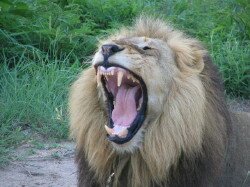
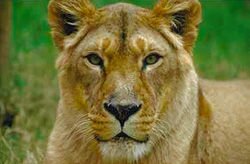
Lion ( panthera leo ) Swahili : simba
Lion are one of the main attractions of the game reserves and are found in all the main ones.They spend most of the day lying under bushes or in other attractive places and when you see a pride stretched out in the sun like this,they seem incredibly docile.It is possible to drive up very close to them in a vehicle,they either don't sense humans or realise that humans in a vehicle are not a threat.Whatever the case,don't be tempted to get out of a vehicle at any time in the vicinity of a lion.Loud noises and sudden movement also disturb them.They are at most active for around four hours in the late afternoon,then spend the rest of the time laying around.Lion generally hunt in groups,with the males driving the prey towards the concealed females who do most of the killing.Although they cooperate well together,lions are not the most efficient hunters,as many as four out of five attacks will be unsuccessful.Their reputation as human-eaters is largely undeserved as in most circumstances they will flee on seeing a human.However,once they have the taste of human flesh,and realise how easy it is to make a meal of one,lions can become habitual killers of people. This mostly occurs among the old lions which no longer have the agility to bring down more fleetfooted animals.Lion are terretorial beasts and a pride of one to three males and up to 15 accompanying females and young will defend an area of anything from 20 - 400 sq km ,depending on the type of country and the amount of game food available. Lion cubs are born in litters averaging two or three.They become sexually mature by 1 1/2 years and males are driven from the family group shortly after this.Lions reach full maturity at around six years of age.Unguarded cubs are preyed on by hyena,leopard,python and hunting dogs.back to the top |
|
|
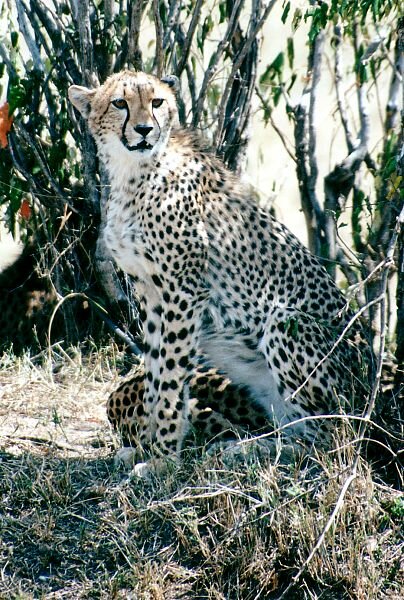
Cheetah ( Acinonyx jubatus ) Swahili: duma The cheetah is one of the most impressive animal you can hope to see:sleek,streamlined and menacing.It is found in small numbers in all of Kenya's major game reserves: Nairobi,Amboseli,Masai Mara,Tsavo,Samburu,Buffalo Springs,Marsabit and Meru.Similar in appearance to the leopard,the cheetah is longer and lighter in the body,has slightly bowed back and a much smaller and rounder face.It stands arounds 80 cm at the shoulder,measures around 210 cm in length,including the tail,and weights anything from 40 - 60 kg .When undisturbed,the cheetah hunts in early morning or late evening,although these days with the number of tourist vehicles around,it is often found hunting at midday when the rubbernecks are back in the lodges stuffing their faces and the poor animal has a chance to to stalk some dinner undisturbed.This forced change in habit is particularly stressful for the cheetah as it relies on bursts of tremendous speed for catching its prey,and this speed up to 110 km/h is only sustainable for a very short time.Obviciously,as the midday heat is much greater than than morning or afternoon,hunting for the cheetah becomes much more difficult.During a hunt the cheetah stalks its prey as close as possible and then sprints for 100 metres or so,if by that time it has not caught its victim,it will give up and try elsewhere.The prey,usually small antelope,is brought to the ground often with a flick of the paw to trip it up.Other food includes hare,jackal and wart hog.Cheetah cubs reach maturity at around one year but stay with the mother much longer than that as they have to learn hunting and survival skills.Cubs are are usually born in litters numbering from two to four,and the main breeding period is from March to December.The cheetah rarely fights predators,mainly of cubs,include lion,leopard and hyenas.back to the top |
|
|
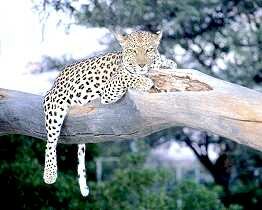
Leopard (panthera pardus) Swahili: chui The leopard is perhaps the most graceful and agile of the large cats.A powerful built animal which uses cunning to catch its prey,it is present in all the major game reserves but it is difficult to find as it is nocturnal and spend the day resting on branches of trees,often up to 5 metres above the ground. It is as agile as a domestic cat in climbing such trees and this is also where it carries its prey so that it's out of the way of other scavengers which might contest the kill.The leopard's coat is usually short and dense with numerous black spots on a yellowish background. The underparts are white and less densely spotted.In addition,the coats of leopards found in open country are generally lighter than those in wooded country.Leopard are solitary animals except during the mating season when the male and female live together.The gestation period is three months and a litter usually consists of up to three cups.They prey on a variety of birds,reptiles and mammals including large rodents,rock hyrax,wart hog,smaller antelopes and monkeys,especially baboon,and occasionally take domestic animals such as goat,sheep,poultry and dogs.This wide range of prey explains why they are still able to survive even in areas of dense human settlement long after other large predators have disappeared.But their presence is generally unwelcome since they occasionally turn human-eater.It also explains why they are found in very varied habitats ranging from semidesert to dense forest and as high as the snow line on Mount Kenya and Kilimanjaroback to the top |
|
|
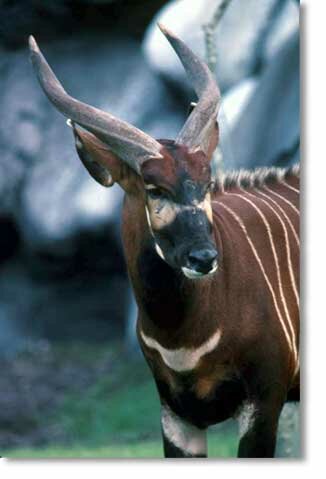
Bongo Antelope(Tragelaphus eurycerus) Swahili:Bongo The large,striped bongo antelope is rarely seen.About your only chance of sighting one is in Aberdare National Park.They live close to water in dense forest,only leaving the forest cover to to graze at night in open clearings.The bongo stands around 120 cm high at the shoulder and measures around 250 cm from head to tail.Mature males are a beautiful dark mahagony-brown colour,while the females are a much lighter reddish-brown.Both sexes have distinctive vertical white stripes on the body,never less than nine,never more than 14.Horns are sported by both males and females,and these are slightly spiralling and lyre shaped with yellow tips,with those on the male slightly shorter and sturdier than on the female.The bongo grazes mainly onleaves and will often stand on its hind legs to increase its reach.It also digs for roots with its horns.Bongo are usually found in small family herds although bulls often lead a solitary existence,meeting up with other animals only to mate.back to the top |
|
|
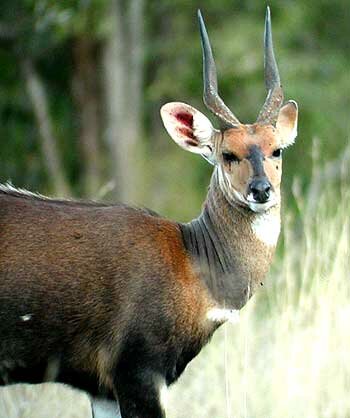
Bushbuck (Tragelaphus scriptus) Swahili : pongo Although the small bushbuck antelope excists in fairly large numbers in most of Kenya's game parks,it is a shy,solitary animal and is rarely sighted.Standing at about 80 cm at the shoulder,the bushbuck is chestnut to dark brown in colour with avariable number of white vertical stripes on the body between the neck and rump,as well as usually two horizontal white stripes lower down which give the animal a harnessed appearance.There are also a number of spots on the upper thigh and a white splash on the neck.Females are reddish brown.Horns are usually only grown by males but females have been known to grow them on rare occasions.They are lyre shaped with gentle spirals and average about 30 cm in lenght.Bushbuck are rarely found in groups of more than two and prefer to to stick to areas with heavy bush cover.When startled they take off and crash loudly through the undergrowth.They are nocturnal animals and browsers yet rarely move far from the choosen spot.Though shy and elusive they can be aggressive and dangerous when cornered.Their main predators are leopard and python.back to the top |
|
|
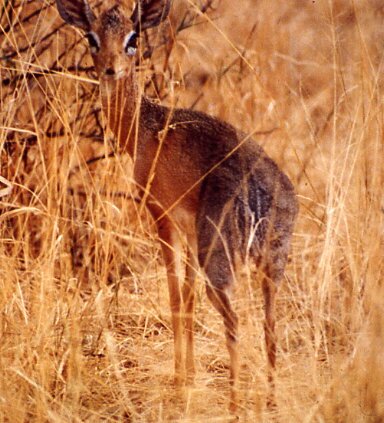
Dik Dik (Madogwa kirki) Swahili: dik dik Kirk's dik-dik is the more common of the two dik-diks found in Kenya.The other is Gunther's dik-dik,found only in Marsabit National Park and Reserve.Kirk's dik-dik is commonly seen in Nairobi,Tsavo,Amboseli and Masai Mara reserves.Its name comes from the "zic-zic" call it makes when alarmed.The dik-dik is a tiny antelope,standing only around 35 cm at the shoulder.It is a redish brown colour on the back,with lighter flanks and white belly.Size is usually the easiest way to identify a dik-dik,but other telltale marks are the almost lack of a tail and the tuft of dark hair on the forehead.Horns are found on the males only and are so short that they are often lost in the hair tuft.Dik-dik are usually seen singly or in pairs and are often found in exceedingly dry places,it seems they don't have a great dependence on water.They are teritorial creatures,each pair occupying an area around five hectares.They are mainly nocturnal but can be seen grazing in acacia scrub in the early morning and late afternoon.Like so many animals they rest in the heat of the day.The females bear a single offspring twice a year.After six month the young dik-dik reaches sexual maturity and is then driven out of the home territory.back to the top |
|
|
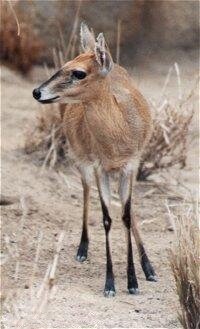
Bush Duiker ( Sylvicapra grimmia) Swahili: nsya Bush Duiker is the most common of the duikers,of which there are at least 10 species.Even so,they are not often sighted as they are largely nocturnal,usually only live in pairs and prefer areas with good scrub cover.They are known to excists in Marsabit,Tsavo,Nairobi,Amboseli,Meru and Masai Mara reserves.The duiker stands only 60 cm at the shoulder,is a greyish light-brown colour with a white belly and a brown vertical stripe on the face.The horns(males only) are short,pointed,and grow straight.Duikers are widely distributed and can be found in a variety of habitats ranging from open bush to semi-desert and up to the snow line of the highest mountains except for bamboo forest and rainforest.This ability to survive in many different habitats explains their survival in cultivated areas where other herbivorous species have been exterminated.They are almost exclusively browsers and only rarely eat grasses though they appear to supplement their diet with insects and guinea fowl chicks.They are capable of doing without water for long periods but will drink it when available.back to the top |
|
|
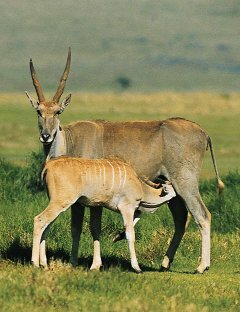
Eland ( Tragephalus 0ryx) Swahili: pofu The eland looks similar to some varieties of cattle seen on the Indian subcontinent,and is found in Nairobi,Tsavo and Masai Mara parks and reserves.The biggest of the antilopes,the eland stands 170 cm at the shoulder and a mature bull can weigh up to 1000 kg.Horns are found on both sexes and these are spiralled at the base,swept straight back and grow up to about 65 cm cm .Males have a much hairier head than the females,and their horns are are stouter and slightly shorter.They are light greyish-brown in colour.and bear as many as 15 vertical white stripes on the body,although these are often almost indistinguishable on some animals.The eland prefers savannah scrub to wide open spaces,but also avoids thick forest.It grazes on grass and tree foliage in the early morning and late afternoon,and is also active on moonlit nights.It needs to drink once a day,but can go without water if its diet includes fodder with high water content.Eland are usually found in groups of around six to 12,but there may be as many as 50 in a herd.A small herd normally consisists of several males,and there is a strict hierachy.Females reach sexual maturity at around two years and can bear up to 12 calves in a lifetime.The young are born in October-November.back to the top |
|
|
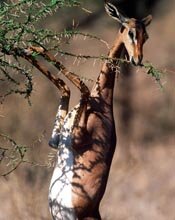
Gerenuk (Litocranius walleri) Swahili: swala tiga The gerenuk is propably the easiest of all antelopes to identify because of its inordinately long neck,which acounts for its Swahili name,swala tiga,meaning giraffe-gazelle.Its distribution is limited to Meru,Samburu,Tsavo and Amboseli National Parks.Growing to around 100 cm at the shoulder,the gerenuk is a dark fawn colour on the back which becomes lighter on the sides and belly.The horns are found on the male only and curve gently backward and grow up to 40 cm long.The gerenuk's habitat ranges from dry thorn bush country to semidesert and its food consists mainly of the tender leaves and shoots of the acacia bushes.It is quite capable,in the same way as a goat,of standing on its hind legs and using one of its forelegs to pull down the higher branches of bushes to get at the leaves and shoots.Also like goats,they are quite capable of doing without water.back to the top |
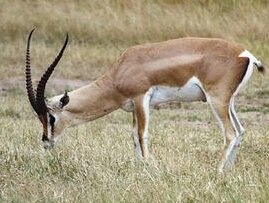 |
Grant's Gazelle (Gazella granti) Swahili: swala granti Grant's Gazelle is one of the most common antelopes and excists in large numbers in Nairobi,Amboseli,Masai Mara,Tsavo and Marsabit reserves.Grant's Gazelle are most easily identified by their colouring and long horns: sandy brown on the back,clearly demarcated from a lighter colour on the flanks and white belly,and white around the tail and hind legs.They are not a large gazelle,standing around 90 cm at the shoulder.Horns are found on both sexes and are heavily ridged with around 25 rings.In the male they grow to around 60 cm,although they often appear longer because of the relatively small body.They curve gracefully and evenly up and back usually with some outward curving as well,in the female the horns are much shorter but follows the same pattern.You usually come across herds of Grant's Gazelle in open grassy country where there is some forest cover,although they are occasionally found in heavily wooded savannah country.Herd size is usually between 20 and 30,with one dominant male,does and young.Food consists mainly of leaves and grass.As water is obtained through dietary intake these gazelles do not need to drink.back to the top |
|
|
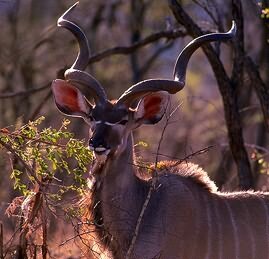
Greater Kudu (Tragelaphus strepsiceros) Swahili: tandala mkubwa The greater kudu is one of the largest of the antelopes but it's a rare sight and only found in any numbers in Marsabit National Park and Reserve.Elsewhere,kudu prefer hilly country with fairly dense bush cover.The kudu stands around 1.5 metres at the shoulder and weights up to 250 kg,yet it is a very elegant creature,light grey in colour,with broad ears and a long neck.The sides of the body are marcked by six to ten vertical white stripes and there is a white chevron between the eyes.Horns are carried only by the males and are both divergent and spiralling.Kudu live in small herds of up to four or five females with their young but these often split up during the rainy season.The males are usually solitary though occasionally they band together into small herds.They are mainly browsers and only seldom eat grasses but are capable of eating many types of leaves which would be poisonous to other animals.Although somewhat clumsy animals when on the move,they are capable of clearing well over two metres when jumping.back to the top |
|
|
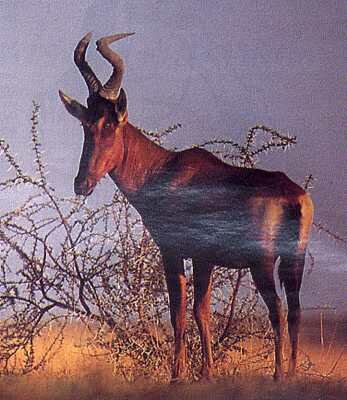
Hartebeest (Alcelaphus buselaphus) Swahili: kongoni The hartebeest is a medium-sized antelope and is found in Nairobi,Amboseli and Masai Mara National Parks and Reserves.It is easy to recognise as it has a long,narrow face and distinctively angular short horns on both sexes which are heavily ridged.Colouring is generally lightbrown on the back,becoming paler towards the rear and under the belly.The back slopes away from the humped shoulders.They prefer grassy plains for grazing but are also found in lightly treed savannah or hills.The hartebeest feeds exclusively on grass,and ususally drinks twice daily,although it can go for months without water if necessary.They are social beasts and often intermimgle with animals such as zebras and wildebeest.Their behavior is not unlike the wildbeest's,particularly the head tossing and shaking.Sexual maturity is reached at around 2 years and calving goes on throughout the year,although there are peak periods in February and August.Predators are mainly the large cats,hyena and hunting dogs.back to the top |
|
|
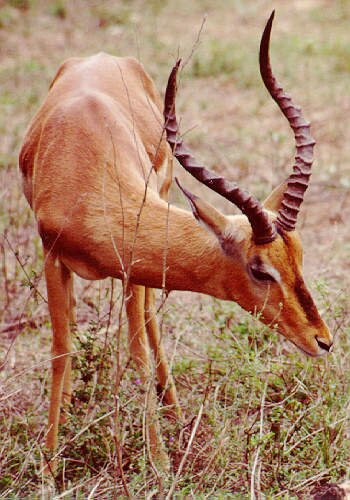
Impala (Aepyceros melampus) Swahili: swala pala The graceful Impala is one of the most common antelopes and is found in virtually all National Parks in Kenya in large numbers.A medium-sized antelope,it stands about 80 cm at the shoulder.The coat is a glossy rufous colour though paler on the flanks with the underparts,rump,throat and chin being white.A narrow black line runs along the middle of the rump to about halfway down the tail and there is also a vertical black stripe on the back of the thighs,but unlike the Grant's Gazelle,this does not border with the white buttocks.It's also distinguishable from Grant's Gazelle by having a tuft of long black hair above the heels of the hind legs.Only the males have horns which are long averaging 75cm,lyre-shaped and curve upwards as they spread.Impala are gregarious animals,each male has a harem of up to 100 females,though more usually around 15-20.Males without a harem form bachelor groups.Fierce fighting occurs between males in rutting season,otherwise they are quite placid animals.One of the most noticeable characteristics of impala is their speed and prodigious ability at jumping.They are quite capable of clearing 10 metres in a single jump lenghtwise or three metres in height and this they frequently do even if there are no obstacles in their path.Impala are both browsers and grazers and are active during the day and during the night.They are quite highly dependent on water but are capable of existing on just dew for fairly long periods.Their man predators are leopard,cheetah and hunting dogs.back to the top |
|
|
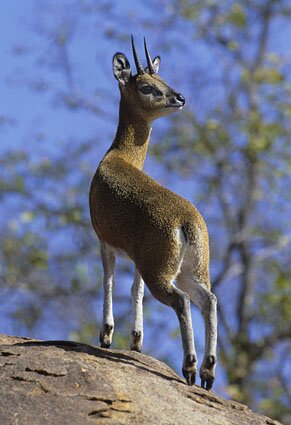
Klipspringer (Oreotragus oreotragus) Swahili: mbuzi mawe The distinctive klipspringer inhabit rocky outcrops in Tsavo,Amboseli,Masai Mara,Marsabit and Meru reserves.Standing about 50 cm at the shoulder,they are easily recognised by their curious tip-toe stance and the greenish tinge of their speckled coarse hair.The hooves are designed for balance and grip on rocky surfaces.Horns,found on the male only ,are 10 cm short and widely spaced.Klipspringer are most often seen on rocky outcrops,or in the grassland in the immediate vicinity,and when alarmed,they retreat into the rocks for safety.They are amazingly agile and sure-footed creatures and can often be observed bounding up impossibly rough rock faces.These antelopes can also go entirely without water if there is none around,getting all they need from the greenery they eat.They are most active just before and after midday,and single males often keep watch from a good vantage point.The klipspringer is usually found in pairs,or a male with two females,and inhabits a clearly defined territory.Klispringer reach sexual maturity at around one year,and females bear one calf twice a year.Calves may stay with the adult couple for up to a year,although young males usually seek their own territory earlier than that.Predators are mainly the leopard and the crowned eagle,but also include jackal and baboon.back to the top |
|
|
Lesser Kudu (Tragelaphus imberbis) Swahili: tandala ndogo The lesser kudu is a smaller model of the greater kudu,the major differences being the lack of a beard,more numerous and more pronounced vertical white stripes on the body,and two white patches on the underside of the neck.As with the greater kudu,only the males have horns.The coat colour varies from brownish grey to blue grey.It stands around a metre high at the shoulder.Kudu usually live in pairs accompanied by their fawns though females occasionally form small herds.They are very shy animals and spend much of the day hiding in dense bush,only moving out of cover to feed in the early morning and at dusk.This makes them difficult to spot.Kudu are browsers and feed on a mixture of leaves,young shoots and and twigs and,thouhg they drink regurlarly if water is available,they are capable of doing without for relatively long priods,more so than the greater kudu.The most likely places you will find them are Tsavo and Marsabit National Parks where they prefer the more drier,more bushy areas.back to the top |

|
|
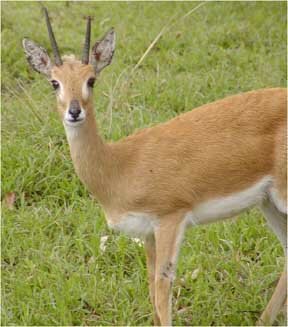
Oribi (Ourebia ourebi) Swahili: taya Not unlike a duiker in appearance,the small oribi is relatively uncommon,and your best chance of spotting one is in the Masai Mara reserve.The oribi's most distinguishing mark,although you will need binoculars to spot it,is a circular batch of naked black skin below the ear,it is actually a scent gland.Another useful indicator is the tuft of black hair on the tip of the short tail.Otherwise the oribi is a uniform golden brown with white on the belly and insides of the legs.Short straight horns about about 10 cm in lenght are found in the males only.Oribi usually graze in grassy plains with good shelter.If water is available they will drink willingly but can also go without it entirely.When alarmed they bolt and then make bouncing jumps with a curious action,all four legs are kept completely stiff.It is thought this helps them to orient themselves in places with poor visibility.After 100 metres or so they stop and assess danger.Oribi are usually found in pairs and are territorial.Sexual maturity is reached at around one year,and the females bear one calf twice a year.Being quite small,the oribi have many predators,including the larger cats.back to the top |
|
|
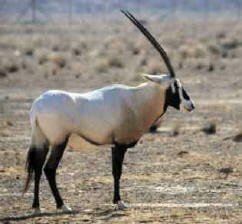
Oryx (Oryx gazella callotis) Swahili: choroa The fringe-eared Kilimanjaro oryx is found in Kenya's Amboseli and Tsavo National Parks and is a large antilope standing around 120 cm at the shoulder.The coat is a sandy fawn with a black spinal stripe which extends to the tip of the tail.The underparts are white and seperated from the lower flanks by another black stripe.There are also two black rings just above the knee of the forelegs.The related gall oryx,oryx gazella gallarum,is reddish grey and is most commonly seen in the Marsabit Reserve and along the Tana river.Note that the oryx species name may also be referred to as beisa.Both types of oryx have ovate,pointed ears with the main distinguishing feature being,as the name suggests,a tuft of black hair on the ears of the fringe-eared one.Oryx are easy to distinguish from other antelopes due to their straight,very long and heavily ridged horns which are carried almost parallel.Both the males and females have horns.These horns come into their own when the animal is forced to defend itself.Held down between the forelegs,they are formidable weapons and used to impale an enemy.Oryx are principally grazers but will also browse on thorny shrubs.They are capable of doing without water for long periods but will drink daily if it is available.Herds vary from five to 40 individuals and sometimes more though the bulls are usually solitary.Oryx are often found in association with zebra and Grant's gazelle.back to the top |
|
|
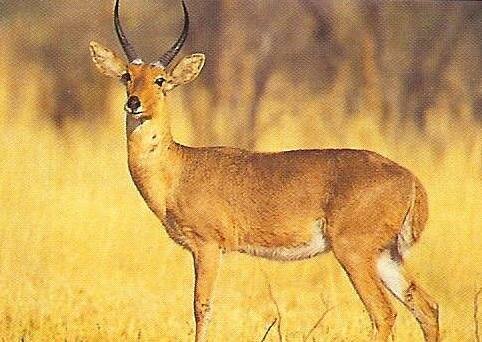
Reedbuck (Redunca redunca) Swahili: tohe The best place to spot the dusty brown reedbuck is in Nairobi and Amboseli National Parks,and they are occassionally seen in Tsavo National Park.The reedbuck is a medium sized antelope,standing around 80 cm high at the shoulder.The most distinctive features are the forward curving horns,found on the males only,and the bushy tail.The underbelly,inside of the thights,throat and underside of the tail are white.The reedbuck frequents open grassy plains or hills and is never found more than around 8 km from a water supply.It is very territorial and is found in small groups of up to 10 animals.The groups usually consist of an older male and accompanying females and young.Its diet consists almost exclusively of grass but does include some foliage.At mating time males fight spiritedly.After reaching sexual maturity at around one year,females bear one calf at a time.The reedbuck's main predators include the big cats,hyena and hunting dogs.back to the top |
|
|
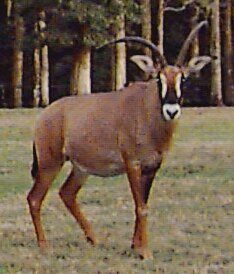
Roan Antelope (Hippotragus equinus) Swahili: korongo The roan antelope is one of Kenya's less common antelope species.The best place to see one is in the Shimba Hills National Reserve,where they have been translocated from other parts of the country,although there are still a few small herds in Masai Mara.The roan is the third largest of the antelopes after eland and kudu.It measures up to 150 cm at the shoulder and bears a striking resemblance to a horse.The coat varies from reddish fawn to dark rufous with white underpants and there's a conspicious mane of stiff,black-tipped hairs which stretches from the nape to the shoulders.Under the neck,there is another mane of sorts consisting of long dark hairs.The ears are long,narrow and pointed with a brown tassel at the tip.The face is a very distinctive black and white pattern.Both sexes have curving backswept horns which can measure up to 70 cm.Roan are aggressive by nature and fight from a very early age,a characteristic which frequently deters predators.For most of the year they live in small herds of up to 20 and sometimes more,led by a master bull,but in the mating season,the bulls become solitary and take a female out of the herd.The pair stay together until the calf is born after which the females form a herd by themselves.They eventually return to their former herd.Herds congrete during the dry season.Being principally grazers,roan rarely move far when food is plentiful but they are susceptible to drought and during such periods they may be constantly on the move.back to the top |
|
|
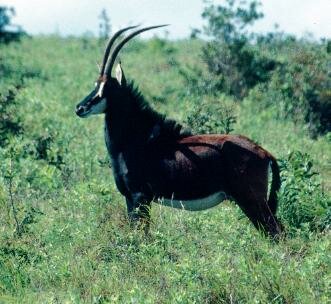
Sable Antelope (Hippotragus niger) Swahili: pala hala Also found only in the Shimba Hills National Reserve,the sable antelope is slightly smaller than its cousin the roan,but is more solidly build.The coloring is dark brown to black,with white face markings and belly.Both sexes carry long backswept horns which average around 80 cm,those of the male being longer and more curved.The sable antelope is active mainly in the early morning and late afternoon,and is found in herds of up to 25 and sometimes more in the dry season.They are territorial and each group occupies a large area,although within this area individual males have demarkated territories of up to 30 hectares.Sables feed mainly of grass but leaves and foliage from trees account for around 10% of their diet.Females start bearing calves at around three years of age,and the main calving times are January and September.Like the roan,the sable is a fierce fighter and has been known to kill lions when attacked.Other predators include the leopard,hyena and hunting dog.back to the top |
|
|
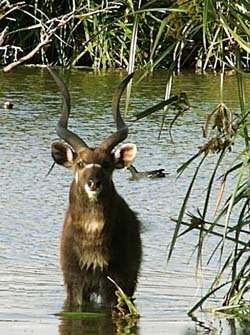
Sitatunga ( Tragelaphus spekei) Swahili: nzohe The sitatunga is an swamp antelope with unusual elongated hooves which gives it ability to walk on marshy ground without sinking.It is restricted solely to the Saiwa Swamp National Park near Kitale,and it is well worth a visit to this small,walkers-only park.Very similar to the bushbuck in appearance,except that the coat of the male is much darker and the hair of both sexes much longer and shaggier,the sitatunga stands something over one metre at the shoulder.The females have a lighter,redish coat and the males have twisted horns up to 90 cm long. It is a fairly shy antelope and sightings are not all that common.A good swimmer,the sitatunga will often submerge itself almost completely when alarmed.It feeds largely on papyrus and other reeds and is usually nocturnal though in places where it remains undisturbed it can be diurnal.Animals normally live singly or in pairs or in pairs but sometimes come together in small herds numbering up to 15 .back to the top |
|
|
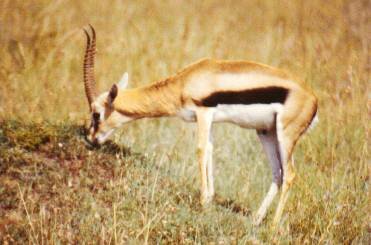
Thomson's Gazelle (Gazella thomsonii) Swahili: swala tomi The small and frisky Thomson's gazelle is instantly recognisable by the black slash across the side which separates the brown back from the white underbelly.They are very common in the plains country,such as in Amboseli,Masai Mara and Nairobi reserves ,but rare in different habitats such as Tsavo National Park.Standing around 60 cm at the shoulders,the Tommy is one of the smaller antelopes.Horns on the male grow to about 30 cm and almost straight with just a gentle curve towards the tips,in the female the horns are straighter and much shorter.Another easy to identify characteristic is the short black tail which seems to be constantly twitching.Along with the oribi,Tommys also do the stiff-legged boucing jump when alarmed.Group size varies,one old largely territorial male may be accompanied by anything from five to 50 females,or there may be herds of up to 500 young males without territory.When food is plentiful the herds tend to be smaller and more territorial.In times of drought herds of several thousand may gather and roam for food.They are often found in close proximity to other animals,including wildebeest and Grant's gazelles.Sexual maturity is reached at around one year but males only mate after establishing their own territory,which occurs sometime after two years of age.Calving occurs throughout the year though tends to peak at the end of the rainy season.Being a small animal,Tommy have many predators,including the big cats,hunting dogs,hyena and serval.back to the top |
|
|
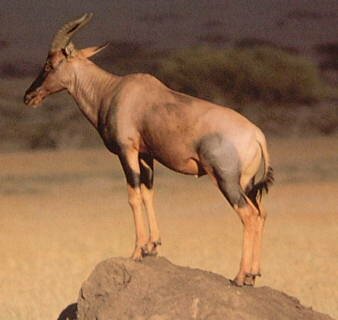
Topi (Damaliskus lunatus) Swahili: nyamera The topi is not unlike the hartebeest in appearance,but is a dark almost purplish colour and has black patches on the rear thighs,front legs and face.Its horns which are found in both sexes,also differ in shape from the hartebeest in curving gently up,out and back.Although fairly widely distributed in East Africa,in Kenya it is only found in Masai Mara where it excists in large numbers.A highly gregarious antelope which lives in herds numbering from 15 up to several hundred individuals,topi congregate at certain times of year in gatherings of up to 10000 in preparation for a migration to fresh pastures.They are often found mingling with wildebeest,hartebeest and zebra.In the mating season,bulls select a well-defined patch of ground which is defended against other rivals and this is where the mating takes place.At this time females are free to wander from one patch to another.After mating,the herds split into single-sex parties.Topi are exclusively grazers and prefer flood plains which support lush pasture though they are capable of thriving on dry grasses which other antelopes will not eat.When water is available they drink frequently but they are also capable of surviving long periods without water so long as there is sufficient grass available.Their main predator is the lion.back to the top |
|
|
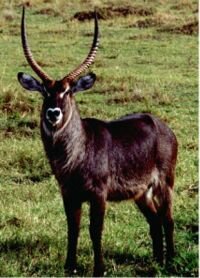
Waterbuck (Kobus ellipsiprymnus) Swahili: kuru The defassa waterbuck is a fairly solid animal is a fairly solid animal and is easily recognisable by its thick,shaggy,dark,brown coat,and white inner thighs.It is fairly common and easily seen in Nairobi and Nakuru National Parks,and in Masai Mara.A second variety,the ringed waterbuck,so-called because of the white ring around its rump,is also seen in Marsabit,Tsavo and Amboseli Parks.Both varieties have white facial and throat markings.Only the males have horns,and these curve gradually outwards then grow straight up to a lenght of about 75 cm .As you might expect from the name,waterbuck are good swimmers and readily enter the water to escape from predators.Their habitat is always close to water,and males have marked territories by the water's edge.Females and younger males tend to wander at random through male territories.Herds are small and usually consists of cows,calves and one mature bull,the other bulls live in small groups apart from the herd.The bulk of the waterbuck's diet is grass but it does eat some of the foliage of trees and bushes.Sexual maturity is reached at just over one year,although a male will not become the dominant bull in the herd until around five years of age.Waterbuck are usually only preyed on when other food is scarce.The reason being that when mature the flesh is tough and has a distinct odour.Predators such as lion,leopard and hunting dogs go for the young calves and females.back to the top |
|
|
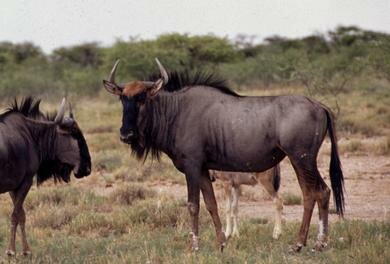
Wildebeest (Connochaetes taurinus) Swahili: nyumbu Wildebeest or Gnu are to the African Savannah what the bison once were to the North American prairies.Numbering in their millions in certain areas,particularly Masai Mara and over the border in Serengeti,they are unmistakable for their prehistoric appearance.Wildebeest are also known as blue wildebeest or brindled Gnu.They are well known for their excentric behaviour which includes loud snorting,tossing and shaking of the head,bucking,running around in circles and rolling in the dust,thought to be a reaction to the activity of the botfly larva which manage to find their way up into their nostrils.They are heavily built with a massive head and wild mane,are somewhat clumsy,and have been described as having the forequarters of an ox,the hind parts of an antelope and the tail of a horse.Their sheer numbers,nevertheless,are testimony to their superb adaption to the environment.Almost entirely grazers,they are constantly on the move in search of good pasture and water,and their annual migration between the Serengeti and Masai Mara and vice versa has to be one of the world's most spectaular sights.Thousands lose their lives in this annual event,drowning in rivers,being taken by crocodiles and other predators or just through sheer exhaustion.The migration north from Serengeti takes place in July and the return trip from Masai Mara in October.They are very gregarious animals and are usually seen in large herds numbering up to tens of thousands in association with zebra,Thomson's gazelle and other herbivores.During the mating season,groups up to 150 females and their young are gathered together by one to three bulls which defend a defined territory against rivals even when on the move.There is apperently no hierachy among the bulls and,at the end of the mating season,the breeding herds are reabsorbed into the main herds.Although they graze in a scattered fashion without any apparent social organisation during the rainy season,they coalesce around water holes and remaining pasture in the dry season.Wildebeest prefer to drink daily and will walk up to 50 km to secure water but are capable of surviving for up to five days without it.There are also noisy animals when grazing,constantly producing a series of snorts and lowpitched grunts.Their main predators are lions,cheetah and hunting dogs though hyena are also very partial to young calves.back to the top |
|
|
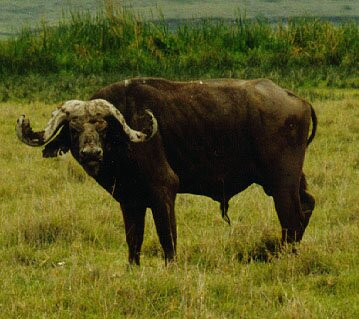
Buffalo (Syncerus caffer) Swahili: mbogo The buffalo is another animal which appears in great numbers in all the major parks,with the exception of Nairobi National Park.The massive animal is said to be the most dangerous to humans of all African animals and should be treated with caution,although for the most part the stay out of your way.Females protecting young calves,and solitary rogue bulls,are the most aggressive,and having 800 kg of angry animal thundering towards you is no joke.Both sexes have the distinctive curving horns which broaden and almost meet over the forehead,although those in the female are usually smaller.The buffalo's colour varies from dark reddish brown to black.Buffalo are often found in herds of 100 or more and never stray too far from water,especially in the dry season.When food and water are plentyful the herds often disperse.They are territorial in that they have a home range of about 50 km outside of which they do not stray.back to the top |
|
|
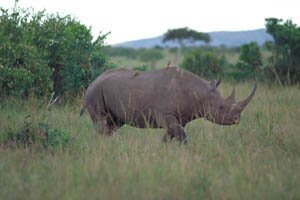
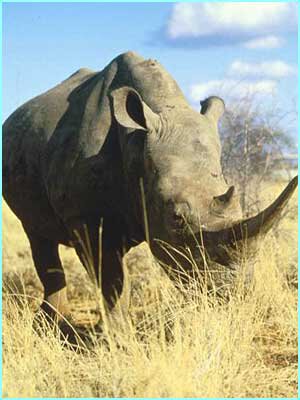
Rhinoceros(Diceros bicornis) Swahili: kirafu One of Africa's most sought-after species by poachers,the numbers of black rhino in Kenya have fallen dramatically in the past,though they are now once again on the increase,thanks to some determined conservation efforts.They are now thought to number around 500,compared with around 20000 in 1970.Rhino are one of the more difficult animals to sight,simply because there are so few in numbers compared to other wildlife.There are seen in Amboseli quite often,and also in Masai Mara,Tsavo East,Nairobi National Park and Nakuru.Rhino usually feed in the early morning or late afternoon,at other times they tend to keep out of sight .The eyesight of the rhino is extremely poor and relies more on its keen senses of smell and hearing.Usually when alarmed it will flee from perceived danger,but if it to charge it needs to be given a wide berth,though with its poor eyesight chances are it will miss its target anyway.Rhinos have been known to charge trains and even the carcasses of dead elephants.A rhino's territory depends on the type of country and and the availability of food,and so it can be as little as a couple of hectares or as much as 50 sq km.The diet consists mainly of leaves,shoots and buds of a large variety of bushes and trees.Rhino reach sexual maturity by five years but females do not usually become pregnant for the first time until around seven years of age.Calves weigh around 40 kg at birth and by three months of age weigh around 140 kg.Adult animals weigh in at anything from 1000 kg to 1600 kg.They are solitary animals,only coming together for some days during mating.Calves stay with the mother for anything up to three years,although suckling generally stops after the first year.back to the top |
|
|
Civet(Viverre civetta or Civetticus civetta) Swahili: fungo The civet is a medium sized omnivore around 40 cm high at the shoulder and 90 cm long,excluding the tail,with some canine features and short,partially retractile claws.Its coat of long coarse hair is basically grey but with a definite and variable pattern of spots over most of the body,along with two black bands stretching from the ears to the lower neck and two black bands around the upper part of the hind legs.The tail is bushy at the base becomimg thinner towards the tip,held out straight when the animal is on the move,and black except for three to four greyish bands near the base.The head is mostly greyish white and the ears are quite small,rounded and tipped with white hairs.Civet are solitary,nocturnal animals which hide in thickets,tall grass or abandoned burrows during during the day and so are rarely sighted.The most likely place to spot one are in Marsabit or Tsavo West reserves.,also they are also known to inhabit Nairobi,Amboseli and Masai Mara.It has a very varied diet consisting of rodents,birds and their eggs,reptiles,amphibians,snails,insects,especially ants and termites as well as berries,the young shoots of bushes and fruits.Litters consist of up to four cubs and these have a similar,though slightly darker colouring.The other conspicious feature of the civet is the presence of musk glands in the anal region which produce a foul-smelling oily substance used to mark territory.This musk is used in the manufacture of perfumes,in Western countries collected from animals held in captivity. back to the top |
|
Genet(Genetta genetta) Swahili: kanu Unlike the civet,the genet distinctively resembles the domestic cat though the body is more elongated and the tail longer and bushier.The coat is long and coarse with a prominent crest aalong the spine.The basic colour varies from grey to fawn and is patterned from the neck to the tail with roundish dark brown to blackish spots.The tail is banded with nine to 10 similarly coloured rings and has a whitish tip.The large spotted or rusty spotted genet(Genetta tigrina) is similar in appearance to the common genet,but has a brownish black spinal stripe and larger spots.The genet lives in savannah and open country and is a very agile tree climber but not frequently sighted since it is entirely nocturnal.During the day it sleeps in abandoned burrows,rock crevices,hollow trees or up in high branches and seems to return to the same spot each day.The animal lives singly or in pairs.Its prey is generally hunted on the ground though it will climb trees to seek out nesting birds and their eggs.Like the domestic cat,it stalks prey by crouching flat on the ground.Its diet consists of a variety of small animals,mostly rodents,birds,reptiles,insects and fruits.It is well known for being a wasteful killer,often eating only a small part of the animal it catches.Litters typically consist of two or three kittens.Like the domestic cat,the genet spits and growls when angered or in danger. back to the top |
|
|
Hunting Dog(Lycaon pictus) Swahili: mbwa mwitu The hunting dog is the size of a large domestic dog and is found in all the reserves,or where there is a high concentration of game animals.The dog's unusual coloration makes it quite an ugly creature,the black and yellowish splotches are different in each animal,ranging from almost all black to almost all yellow.The only constant is the white tail tip.Prominent physical features are the large rounded ears.Hunting dogs tend to move in packs ranging from four to five up to as many as 40.They are efficient hunters and work well together.Once the preyhas been singled out and the chase is on,a couple of dogs will chase hard while the rest pace themselves,once the first two tire another two step in and so on until the quarry is exhausted.Favoured animals for lunch include gazelle,impala, and other similar sized antelope.They rarely scavenge,preferring to kill their own.Hunting dog cubs are usually born in grass lined burrows in litters averaging seven,although litters of up to 15 are not unheard of.By six month they are competent hunters and have abandoned the burrow.The hunting dog has no predators,although unguarded cubs sometimes fall prey to hyena and eagle. back to the top
|
|
|
Hyena(Crocuta crocuta) Swahili: fisi The spotted Hyena is a fairly common animal throughout most of Kenya and especially where game is plentiful.Bearing a distinct resemblance to dogs,it is a large,powerfully built animal with a very sloping back,broad head and large eyes but with rather weak hindquarters.The sloping back is what gives the animal its characteristic loping gait when running.Its coat is short,dull grey to buff and entirely patterned with rounded blackish spots except on the throat.Its powerful jaws and teeth enable it to crush and swallow the bones of most animals except the elephant.Hyena are mainly noctural animals but are frequently seen during the day,especially in the vicinity of lion or cheetah kills impatiently waiting for their turn at the carcass along with vultures.Otherwise,the days are spent in long grass,abandoned aardvark holes or in large burrows which they dig out up to a metre below the surface of the soil.It is a very noisy animal and when camping out in the bush at night you will frequently hear its characteristic and spine chilling howl which rises quickly to a high pitched scream.This is only one of the sounds which the spotted hyena emits.Another is the well known laugh,though this generally only produced when the animal finds food or is mating.The hyena has highly developed senses of smell,sight and sound,all important in locating food,carrion or prey,and for mutual recognition among pack members and mating pairs.Hyena are well known as scavengers and can often be seen following hunting lions and hunting dogs,usually at a respectable distance,though they will occasionally force these animals to abandon their kill.On the other hand,although carrion does form an important part of their diet,hyenas are also true predators and are more than capable of bringing down many of the larger herbivores.To do this they often form packs to run down wildebeest,zebra and gazelle,and are able to reach speeds of up to 60 km/h.They also stak pregant antelope and,when the female gives birth,snatch and kill the newly born foal and occassionally the mother too.Domestic stock are also preyed on.In the mating season,hyena assemble in large numbers especially on moonlight nights.All hell breaks loose on these occasions and the noise is incredible.The gestation period is about 110 days and litters number up to four though usually less.The young are born in the mother's burrow.The pups are weaned at around six weeks old and become independent shortly afterwards.Humans are the hyena's main enemy,though lions and hunting dogs will occasionally kill or mutilate hyenas if they get too close to a kill.Although they are reputed to be cowardly,you are adviced to keep your distance from them as they do occasionally attack humans sleeping in the open. back to the top |
|
|
Jackal(Canis aureus) Swahili: bweha There are two species of Jackal found in Kenya.The common or golden Jackal and black backed jackal (Canis mesomelas),which is a common sight in the major reserves.The black back which gives it its name is usually more silvery thn black,is wide at the neck and tapers to the tail.The golden jackal is similar,though without the back markings.Although the jackal is in fact a dog,its bushy tail and long ears are more like a fox.The jackal is mostly a scavenger and so is commomly seen in the vicinity of a kill.The jackal will hunt for itself,insects,small mammals,birds,and the occasional small antelope.They are also found around human settlements and will attack sheep,poultry and calves.Jackal are territorial and a pair will guard an area of around 250 hectares.Cubs are born in litters of five to seven and,although they do not reach maturity until almost a year old,they usually leave the parents whenjust two months old.Enemies of the black backed jackal include the leopard,cheetah and eagle. back to the top |
|
|
Mongoose(Mungos mungo) Swahili: kicheche The banded mongoose,the one most commonly found in Kenya is usually seen in groups in Tsavo,Amboseli and Masai Mara reserves.It is brown or grey in colour and is easily identifiable by the dark bands across the back which stretches from the shoulder to the tail.The animal is about 40 cm in lenght and weighs between 1.3 and 2.3 kg.Mongoose are very sociable animals and live in packs of between 30 and 50 individuals which stay close to one another when foraging for prey.They are often very noisy,having a wide variety of sounds whichthey use to communicate with each other.When threatened they growl and split in much the same manner as a domestic cat.Being diurnal animals,they prefer sunny spots during the day but retire to warrens,rock crevices,hollow trees and abandoned anthills at night.A pack frequently has several warrens within its territory.The mongoose's most important source of food are insects,grubs and larvae but they also eat small amphibians,reptiles,birds' eggs,fruits,berries and birds.Their main predators are birds of prey though they are also taken by lion,leopard and hunting dogs.Snakes rarely pose a danger since these would be predators are attacked by the entire pack and the snake is frequently killed.Mongoose are one of the creatures which have become very habituated to humans in some places and come right up to the game lodges scavenging for scraps. back to the top |
|
|
Serval(Felis serval) Swahili: mondo The serval is a wild cat,about the size of a domestic cat but with much longer legs.It is found in all the major game reserves in Kenya.The serval's colouring is a dirty yellow with large black spots which follow lines along the lenght of the body.Other prominent features are the large upright ears,the long neck and the relatively short tail.It stands about 50 cm high and measures 130 cm including the tail.Being a largely nocturnal animal,the serval is usually only seen in early morning or late evening.It lives on birds,hares, and rodents and is an adept hunter,it catches birds in mid flight by leaping into the air.Serval cat young are born in litters of up to four and although independent at one year, do not reach sexual maturity until two years of age. back to the top |